

On this occasion visitklaten.com will discuss more about gamelan devices that hopefully can add insight into Javanese culture that has begun to gradually disappear.
Gong
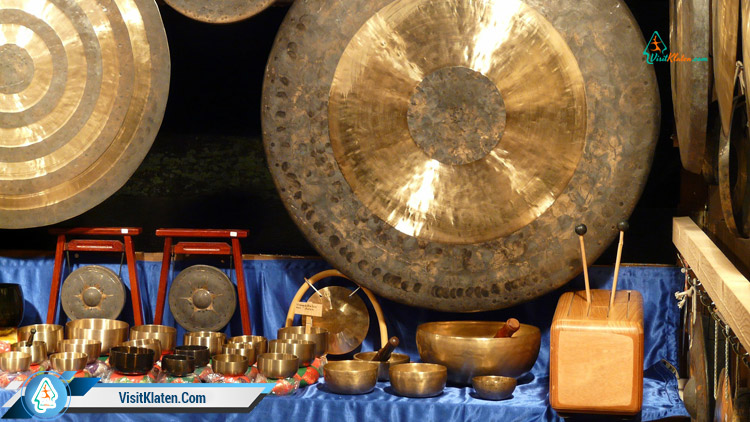
Gong is one of the famous musical instruments in Southeast Asia and East Asia. Gong is used for traditional musical instruments. Now there are not many gong artisans. The gongs that have been forged cannot be determined yet, but new gong tones can be formed after rinsing and cleaning. If the tone is still not suitable then the gong is scraped until the bronze layer becomes thinner.
Gong has several kinds, among others, namely Agung, Babendil, Bonang, Gong ageng, Gandingan, Kenong, Khong mon, Kempul, Kempyang and knock, Coil Gong, feng gong, tam tam, paiste symphonic, Kulintang, chau gong, nipple gong (boa gong), flat gong, rin gong, Bait, Kkwaenggwari – thin little gong and Jing – big gong
Xylophone
Gambang is a traditional musical instrument and consists of 18 bamboo blades and is played by being beaten. This musical instrument is used in the art of gambang kromong Betawi, a type of orchestra that combines gamelan with Chinese musical instruments such as tehyan, sukong, and kongahyan.
Siter and Celempung
Siter and celempung are stringed instruments inside Javanese gamelan. There is also a connection with the harp in Sundanese gamelan. Siter and celempung each have 11 and 13 pairs of strings, both sides are stretched between the resonator boxes. The siter and celempung have a characteristic that is on one string set with a pelog tone and on the other string set with a slendro tone. Generally the siter has a length of about 30 cm and is inserted into a box when played, while the celempung has a length of about 90 cm and has 4 (four) feet, and is set in an octave under the siter. Siter and celempung function as one musical instrument that is played together or panerusan and as an instrument that plays cengkok which is a melodic pattern based on balungan. Siter and celempung are played using the same speed as xylophone, which is fast tempo.
The siter’s name originated in Dutch, namely citer and also related to English, namely zither. While Celempung is related to Sundanese celempungan musical form. The siter string is played using the thumb while the other fingers are used to resist vibrations when other strings are picked, this is usually a characteristic of gamelan instruments. The second hand finger is used to hold the finger using the right hand position under the string while the left hand finger position is above the string. Siter and celempung with various sizes are typical instruments of the gamelan siteran, although they are also used in various other types of gamelan.
Note: Sorry if the image does not match the contents of the article
Thank you for visiting our website
Visit klaten – Klaten Tourism and Advertising Map – Let’s Go To Klaten !.
Is a media of Tourism Information and Advertising Media in the area Klaten, Surakarta, Yogyakarta, Boyolali, Karanganyar and surrounding areas.
Share if useful, if any criticism, additional and suggestion please contact us or please fill in comment field
#visitklaten #visitklatencom #klaten
